Gym SEO, The Complete Guide for Gym Owners

 
Most gym websites go unnoticed.
 
A gym owner invests in a nice website, adds the class schedule and pricing, then waits. But no one visits because no one finds the site. Meanwhile, the gym down the street, with a less impressive website but a stronger Google profile, gets all the sign-ups.
 
Gym SEO fixes this by making sure your gym shows up when local residents search for a place to train. When done right, it consistently attracts new members without ongoing advertising costs.
 
This guide details the complete process I use with fitness businesses, including keyword research, Google Business Profile setup, on-page SEO, local links, content creation, and tracking. It is written specifically for gym owners.
 
For example, one of my pages showed up in Google search results 1,871 times over six months for terms such as “fitness seo” and “seo for gyms.” However, it ranked under the first page receiving no clicks. Appearing behind the first page is always considered invisible. So I improved it using the basic steps outlined below.
 
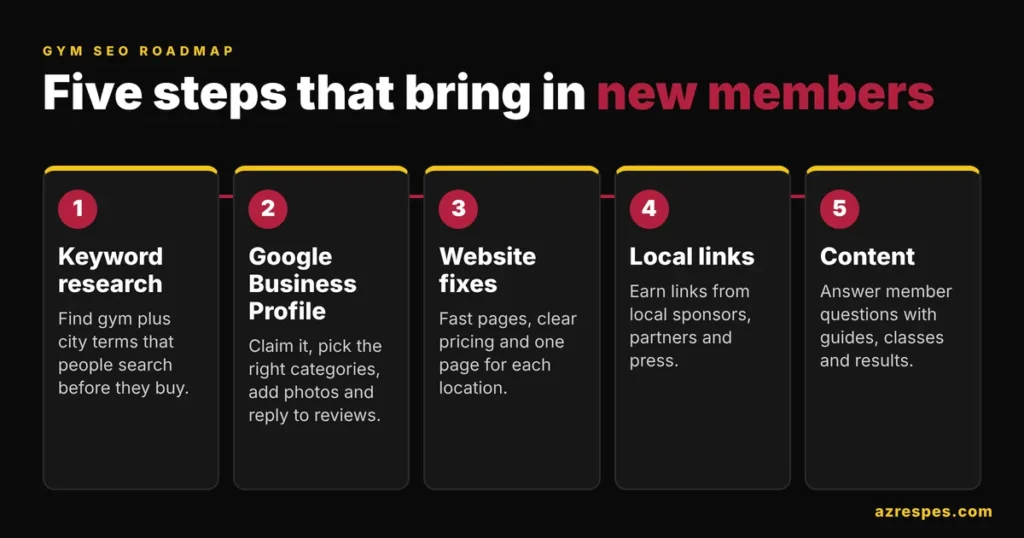
To break it down I talk about: claim and optimize your Google Business Profile, create a dedicated page for your location(s), get reviews using related terms, earn links and citations, and publish content that tackles member questions. Review your results monthly.
Five step gym SEO roadmap from keyword research to Google Business Profile, website fixes, local links and content

Full Breakdown

What Is Gym SEO and Why Gym Owners Need It

Gym SEO is search engine optimization for gyms, fitness centers, and studios. The goal is simple. When someone searches “gym near me”, “24 hour gym” or “personal training in [your city]”, your business shows up near the top.
 
Search engines such as Google read your website, your Google Business Profile, and other sites that mention something about you. They use that information to decide which gyms to show and in a particular order. The marketing channel, SEO is the best practice of giving your gym a clear, legit, and trusted signals about your business.
 
This is why it matters for making revenue. People who search for a gym are close to making a decision. They are not scrolling for fun. They’re searching for a nearby place to train, and many join within days of finding one. If your gym isn’t on that first page, expect your competitor to receive the additional sign-ups.

Gym SEO vs Fitness SEO

Fitness SEO is the much larger category. That category covers gyms, personal trainers, studios, supplement brands, apparel brands, and fitness ecommerce stores. Gym SEO is focused on helping people find a physical business in a specific area.
 
If you run a gym, you need local signals and strong content. If you’re selling supplements or activewear through e-commerce or an online store, you’ll need to use supplement brand SEO and fitness apparel keywords instead.
 
Making improvements for gym SEO is worth to your local business. One member can stay for years. A handful of extra sign-ups start in January, then add up fast each month, and paid ads stop working the moment you stop paying for them. SEO works differently. The service pages and profiles you build today keep bringing in leads the following quarter and next year, and steady monthly work makes next month easier.
 
Having SEO builds online visibility, including AI visibility that you own. You’re not renting space from an ad platform. You are building a long-term asset that works for your fitness brands around the clock.

How Gym SEO Works for Fitness Centers

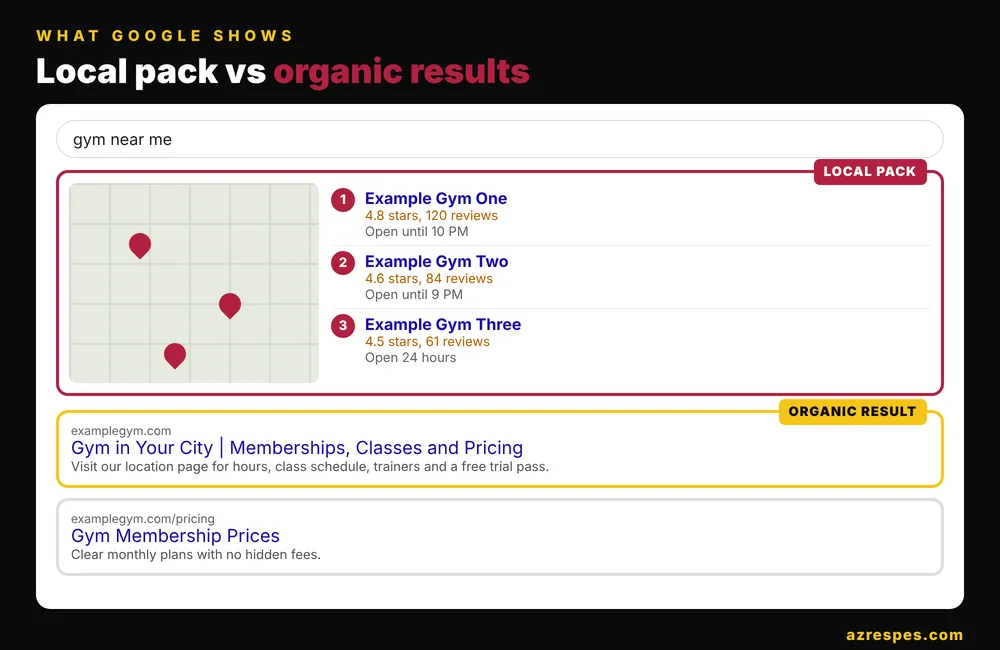
When people search for a gym, Google usually shows different kinds of results. Knowing them tells you where to spend your effort. Local SEO is the different type of SEO that earns you a spot in the Google & Apple map results, and organic SEO is the part that earns you rankings on the results page below it. Now search engines include AI Overviews with listing results. Strong gyms work on both for a better appearance.

The Local Pack

Google search results for a gym showing the local map pack above regular organic listings
The local pack is the map on Google and Apple phones with a short list of gyms, at the top of the page. It pulls from Google Business Profiles. Google ranks listings based on a few factors including:
  • Relevance is how well your profile fits the search.
  • Distance is how close you are to the searcher.
  • Prominence is how well known and trusted you look
  • Reviews and citations across the web as just a few factors

Organic Results

Below the map on a Google results page sit the regular blue links. Those links are the results coming from your websites. A gym that ranks on the SERP has clean service pages, one page per location, fast load times, and link recognition from other sites. Organic results include guides and directory pages, so you’re competing with more than just other gyms.

Search Intent

Keep in mind people search with different intent. Typing “gym membership deals near me” signals purchase intent and ready to act. “Best gym for beginners” is comparing and weighing out the options. “How to stay consistent at the gym” signals a desire to learn and improve workouts. Match each page to the intent behind its keyword, and win the conversion. Miss the intent, and you lose, even with good writing.
 
My fitness keywords list sorts more than 180 terms by intent, so you can see which are buy, compare, and learn searches.
 
Studios and specialty gyms, yoga studios, CrossFit boxes, and even Pilates studios each have their own search audience. People search for the type of class they desire, in that city, such as “hot yoga [city]” or “crossfit near me”, far more than searching for the word gym. Build your keyword cluster around what the classes you teach, the training exercises you offer, and use the same steps in this guide.

Step 1. Find the Keywords Your Members Search

Doing a bit of keyword research will tell you which words your future members type into Google. If you skip this step, consider every other step to point you in the wrong direction.

Build Your Keyword List

First, start with what you already have. Open Google Search Console, look at the Queries and download the report. Filter by impressions. Any search where you sit between position 4 and page 2 is a quick win, since Google already likes your page and a stronger version can reach page one. Most gym owners have never heard about this tool, let alone made a report, and it is free to use.

Build a Keyword List by Business Type

For a local gym, money keywords should always include a location or a feature. Think about terms such as “24-hour gym [city]”, “women-only gym [city]”, “gym with sauna near me”, “gym membership deals [city]”, and “group fitness classes [city]”.
 
A handful of keyword research tools can help. Tools like Ahrefs, Semrush, Keyword Cupid, Keyword Planner, and many others show search volume and keyword difficulty. If you’re just getting a new site off the ground, aim for keywords with low difficulty and clear buying intent. A targeted group with a small search that’ll buy beats a big search with a window shopper behind it. Chase the buyer.

Assign One Keyword to One Page

The most important thing is to dedicate one page to one main keyword. That is the requirement. A repetitive theme I see is two pages targeting the same term; that hurts your rankings and confuses Google.
 
Here’s an example of why keyword structure helps. A lot of times, your homepage might target your business name, “gym in [city]”, your pricing page “gym membership [city]”, and each class page its own class name plus the city. All of those terms create chaos and are set to collapse. Organize the funnel flow. Lay out the keyword strategy in a simple sheet before you go to work.
 
Make your homepage a target for branding or “gym in [city]”. The pricing page can target users searching for “gym membership cost [city]”. Have service pages for “hiit classes [city]” and “spin classes near me”. Your staff can be a personal training page for “personal trainer [city]”.
 
Finally, add blog posts that answer the questions members ask before they join. That setup alone puts you ahead of most fitness centers.

Step 2. Set Up and Optimize Your Google Business Profile

When you establish gym SEO, your Google Business Profile does more work than your website. It helps drive Google Maps and Apple Maps results, the call button, directions, and as much “near me” traffic as possible. Treat it like a sales or landing page, since most people see it first.

Claim, Verify, and Fill In Everything

Claim the profile, verify it, and complete every field. Use your real business name without keyword stuffing, since stuffing violates Google’s guidelines and can get your profile suspended. Add your address, phone number, hours of operation, website link, class schedule link, and a short description written for the people.

Pick the Right Categories

Picking your primary category matters the most. “Gym” is the obvious choice for most places. Make sure you put additional categories that match what you offer, such as personal trainer or yoga studio, and skip the ones that don’t necessarily apply. Google changes the available names from time to time, so check the live list when you set it up.
 
Upload real photos and videos of your gym equipment, the front door, locker rooms, classes, staff, whatever media that brings the place life. People judge a gym by its photos and videos before they visit. Refresh them every few months, since a profile with old photos looks abandoned.


Collect and Answer Reviews From Customers

Google looks at reviews as a “user-generated content” signal. Reviews sway both rankings and decisions. Ask clients and members to leave a review at the right moment, such as after a milestone or a great class, as they leave, and send them a direct link. Reply to every review, good or bad, calmly and professionally.

Step 3. Fix Your Gym Website With On-Page SEO

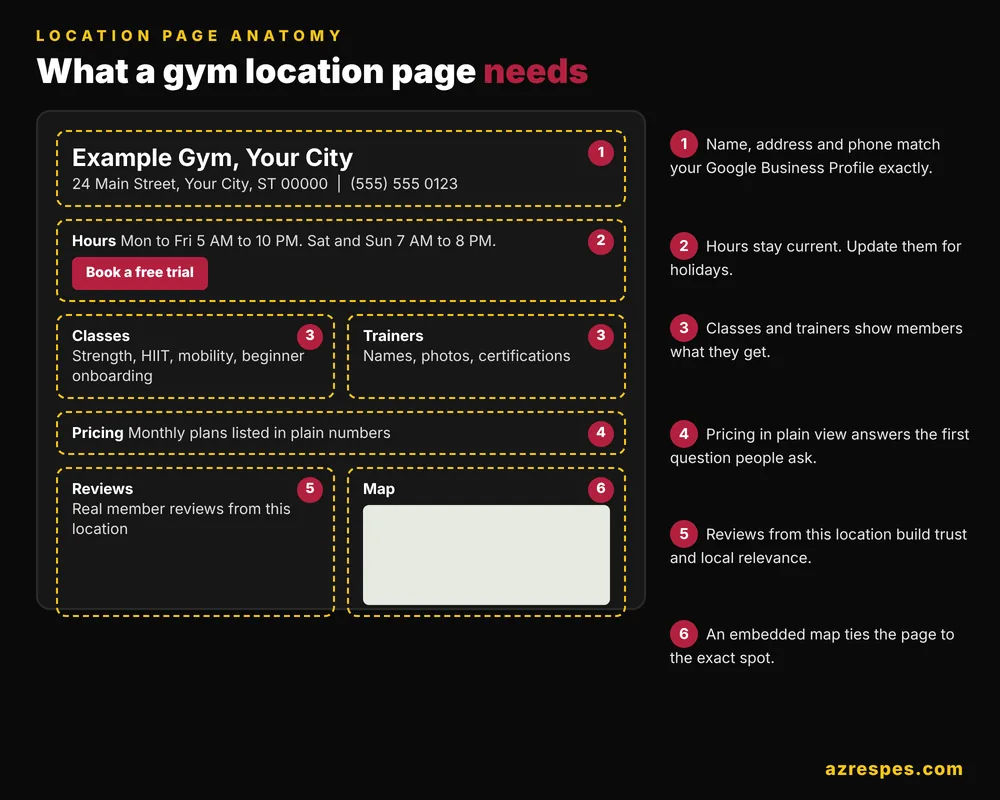
Example gym location page with address, hours, classes, reviews and map labeled for local SEO
Your website is your company’s home base. Your website gives Google the details that a business profile cannot. Each webpage should answer questions clearly.
 
This is what you should fix first.

Title Tags, Meta Descriptions and Headings

The title tag is the blue headline you notice on a search results page. You want to put your main keyword plus the city in that section. “Elite Gym in Tampa, Classes and Personal Training” sounds better than “Home”.
 
Write a meta description underneath that is going to sell the user to click in about 150 characters.
 
For the pages you work on, use only one H1 per page, then create a sub header structure starting with H2 headings for each section.

Dedicate One Page Per Location Effectively

If you have more than one location, give each gym its own dedicated page with a physical address, hours, map, photos, parking details, reviews, and the classes taught there.
 
Even though cloning pages seems like a simple cop-out, it’s best not to clone a page and just swap the city name. Google treats near-duplicate pages as thin content, and members can tell if you’re not familiar with the location; you’ll eventually lose trust.
 
Another, and best, route is to build a locations hub page that links to every gym, then give each gym its own page with its own Google Business Profile.
 
Franchise owners should keep the brand consistent while still adding local details to each page. Include things such as neighborhood names, local coaches, and nearby landmarks. That gives those pages a different look for users and search engines. This is the step most multi-location brands skip.
 
Build a page for each major class, program, and equipment, plus one clear pricing page. Hiding prices behind a form loses the people who want an answer upfront. Add a short FAQ on each page to help.
 
To gain new memberships and capture navigational or buyer-intent searches, you’ll need to strengthen your service pages. Future members search for “spin classes near me”, “hiit classes [city]”, and “gym membership cost”.

Structured Data

Schema markup is additional code that tells Google and search engines what a page contains. You’ll want to use LocalBusiness or ExerciseGym schema throughout the website, with the right NAP information. Look to use FAQ schema on pages that answer all questions.
 
Double-check everything in Google’s Rich Results Test or go to Schema.org and validate. If your website runs on WordPress, plenty of SEO plugins, like RankMath, handle part of it, but not all of it. 
 
A few other important subjects I need to mention involve the technical side of SEO: speed, mobile, and security. Most gym searches happen on a phone, so you should test your site in Google PageSpeed Insights and GTmetrix.
 
We know promotion includes videos and images.  When you upload to desktop, it’ll be more effective to compress images, skip heavy sliders, and make sure the site runs on HTTPS. People’s patience with technology runs thin, and if your class schedule takes ten seconds to load, visitors leave and book with the next gym.
 
Web design plays a real role in how a website comes together. A gym site built on a terrible theme with huge background videos that take forever to load will struggle to rank, no matter how good the content is.
 
Clean and fast beats flashy every day. All forms of digital marketing for gyms work best when the website, the Google profiles, and content all pull in the same direction.

Internal Links and Site Structure

Internal linking remains underrated and underused when building topical authority. Internally link your pages together down the proper funnels.
 
Your homepage should link to each location, each location to its classes, and your blog posts to the service pages they support. Use not only navigation links but also proper anchor tags in the body text with related terms.
 
Internal links tells Google which pages matter most, giving you trust with authority and guide visitors toward joining. 
 
Want a checklist to work through? Use my fitness website SEO checklist.

Step 4. Build Local Citations, Reviews and Backlinks

Google and other search engines still use various sources of backlinks; especially with location businesses. Google trusts gyms that other sites mention. This step creates Google putting trust in you by other votes.

Local Citation and NAP Consistency is Real

A local citation is a mention of your business name, address, and phone number (NAP) on a directory site. Think Yelp, Apple Maps, Bing Places, Facebook, Nextdoor, and local directories as your primary citation sources.
 
Match your NAP everywhere, from down to “Street” versus “St.” Mismatches confuse search engines. Audit your listings once, fix the errors, and check them again every year.

Grab Local Backinks

Backlinks from real local sites are one of the strongest signals outside your own pages. The good news is gyms have more link opportunities than most businesses, since you are part of the community.
 
Sponsor a youth sports team or the next local school game, the annual charity run, or a local race. Partner with physical therapists, nutrition shops, running clubs, and corporate wellness programs down the block or in the same plaza. Each partner can link back to you from their site with QR codes.
 
Reach out to the cafe down the street for a partnership promotion, and get involved by hosting a community workout, charity challenge, or free class on the weekends. Send the details to local news sites, community blogs, and event calendars. Every single link from a local site has more influence than dozens from random directories.
 
Search around the net for your gym name on Google. When a site mentions you without a link, send a civil email asking them to add one. It takes five minutes and works more often than you would expect.

Step 5. Publish Content That Brings In Members

Your service pages is the money that capture people who are ready to join. Blog posts bring people who are looking information, perhaps undecided, yet they give you more chances to rank across the whole fitness industry. Write about what your members ask at the front desk as a source.

Create Topics That Work for Gyms

One of the easiest ways to drive fast traffic to you is getting the popular topics out the way.

Popular topics including “how much is a gym membership”, “first time at the gym”, “gym etiquette”, “beginner full body workout”, “gym vs home workout,” and “how to cancel a gym membership” are great conversion feeders that drive traffic. Each one answers a real question and links to a page where the reader can join.

Don’t be afraid to use your own coaches as authors. A real name and real expertise on the page support Google’s EEAT guidelines, which stand for experience, expertise, authoritativeness, and trustworthiness.
Share Member Stories and Proof

The fitness industry is about self-care while inspiring others. It is essential that you share member results and testimonials. Keep their story in their own words, plus before/after photos with the program they used.
 
More proof builds trust with search engines and new visitors, and it is content your competitors cannot take away from you. Treat each one as important as the last one. These are the small case studies for your gym.

Social Media and Email Marketing Support SEO

While social posts do not directly raise your rankings, they do bring branded searches, shares, reviews, and visitors to your site, and those are signals worth building. Plus, social bookmarks create substantial backlink juice for your website.
 
Post class highlights, coach tips, and member wins on Instagram, Facebook, YouTube, TikTok, and other social platforms. Include links in the posts, along with links from your website profiles.
 
Email marketing is another channel that gives you direct and referral traffic you own. Create flyers and promotions. Send class updates, challenges, and offers to leads and past members so you do not depend on Google alone.

How to Track Gym SEO Results

If you do not measure your results, you are guessing. Set these Google tools up in the first week.

The Numbers That Matter in Google Software

Google Search Console will show you impressions, clicks, average position, and the exact queries (searches) that find you. Google Analytics (GA4) shows what visitors do after they land on your site. Google Business Profile gives insights showing calls, direction requests, and website clicks.
 
Set up call tracking and form tracking to show which pages produce leads and trial sign-ups.

How Long Gym SEO Takes

Typically, you can expect three to six months before local rankings move meaningfully, and longer in crowded cities. But that’s not always the case; local SEO can start within 45 days when competition is low. Your Google Business Profile can show results much sooner, sometimes within weeks.
 
New websites take longer than established ones with national terms, so anyone who promises page one in 30 days is selling you a personal story.
 
Google Ads can bring leads this week, making it useful for a new location or a launch offer. The thing is, you need to keep costs consistent. Stop paying, and the leads stop. Gym SEO might take a little longer to start, but that asset keeps paying after the work is done. The gyms that do both do the best.
 
Evidently, shifting the budget toward SEO helps more rankings grow.

Gym SEO Mistakes That Cost You Members

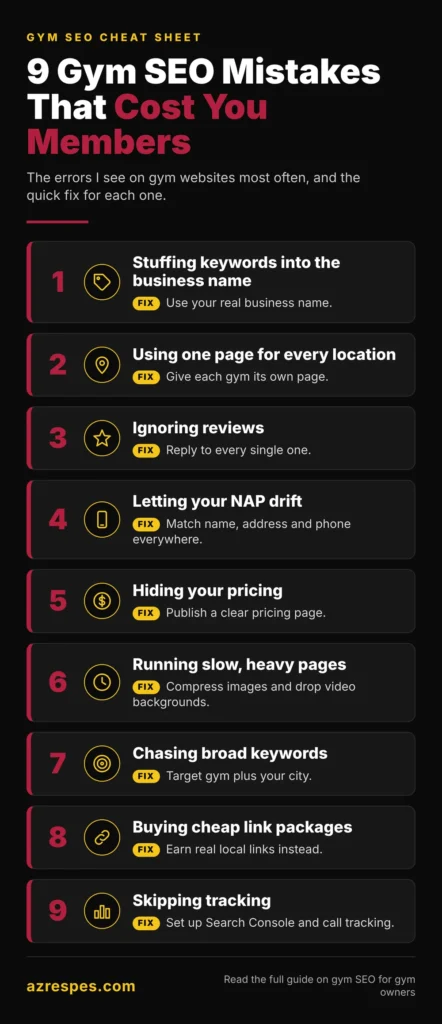
These are the errors I see most often on gym websites:
  • Stuffing keywords into the business name
  • Using one page for every location
  • Ignoring reviews
  • Letting your NAP drift
  • Hiding your pricing
  • Running slow, heavy pages
  • Chasing broad keywords
  • Buying cheap link packages
  • Skipping tracking
gym seo mistakes infographic

Gym SEO Services: Do It Yourself or Hire Help

You can do the steps above yourself using my ranking strategy. Many gym owners handle the first three steps alone and bring in SEO services for links, content, and tracking. The real question is how much time you have, since SEO takes steady weekly work.

What to Look For in SEO Services For Gyms to Include

A real SEO services package includes a full technical audit, keyword research, content, on-page adjustments, off-page optimization (including your Google Business Profile), local citations, link building, brand awareness, quality, and monthly reports you can understand.
 
Most digital marketing agencies bundle SEO with web design, social media, and Google Ads. Bundles work when each piece has a purpose and a price.

How Much Does Gym SEO Cost?

Pricing depends on your city, competition, the number of locations, and how much content you need. Each market is different and creates a foundation. Ask for a scope of work before requesting a price. A single gym in a small town needs far less than a franchise in a major city.
 
Compare what is included, not just the monthly fee.

Red Flags to Avoid

Confidence, experience, and a skill set are different from guaranteeing rankings. Ask for case studies from rankings and results either similar to yours or with the type of SEO you need (local/franchise), not a page of logos. Ask who does the work and ask what access you will have. 

Book a Free Gym SEO Audit

Fortunately, I run SEO consulting for fitness, supplement, and wellness brands. In a free audit call, I pull up your site live and show you the three fastest wins for your gym, what is holding your rankings back, and what I would fix first.
 
No pitch deck. If it makes sense to work together, we talk. If not, you leave with a plan.
If you’re not ready for a call, that’s okay. Start with my free fitness keyword cheat sheet and build your keyword map first.

Gym SEO FAQ

What is SEO in fitness?

SEO in fitness is the practice of improving the visibility and overall performance of gyms, personal trainers, studios, and fitness brands found in Google Search and Google Maps. It combines keyword research, a strong Google Business Profile, on-page SEO, local links, and useful content so the right people find your business when they search.

How do you implement SEO for a gym?

Start with keyword research, publish content, build one page per location and class. Then set up your Google Business Profile, collect reviews, earn local links, and track your results in Google Search Console and Analytics. Follow the steps mentioned in the order above.

What does SEO stand for in sports and fitness?

SEO stands for search engine optimization. In sports and fitness, it means improving your website and online profiles so search engines show them to people looking for gyms, coaching, classes, supplements, or gear.

What are keywords for fitness?

Fitness keywords are the words and phrases people use on Google when they’re looking for a gym, a personal trainer, a workout program, or a fitness product. These keywords include “gym near me”, “personal trainer [city]”, and “best pre workout”. You can find more than 180 in my fitness keywords list.

How long does gym SEO take to work?

Most local gyms typically start showing meaningful movement within the first three to six months. Google Business Profile improvements can show up faster, in as little as 2 weeks. Consistent work matters more than any single fix.

Pick one step from this guide and finish it this week. Your Google Business Profile could be a best place to start.

Related Posts

Join Our Newsletter